
Do You Need Special Insurance for Commercial Moving in NYC?
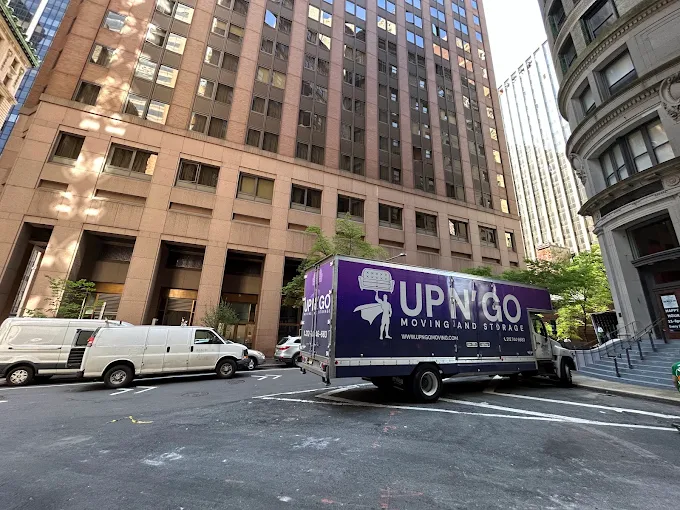
Yes, in almost every case, and there’s not much wiggle room on this one. A commercial move in New York City requires a Certificate of Insurance issued to your building before a crew is even allowed past the loading dock, and the coverage limits on that certificate are set by building management, not by you.
We handle those relocations at Up N Go Moving & Storage, licensed movers in Queens, NY, who issue the certificates as part of the job instead of tacking it on as an extra.
Our coordinators collect the building requirements before we quote, because naming the wrong entity on that certificate is about the fastest way to lose a reserved freight elevator window, so ask your property manager for their COI sample this week, not the week of the move.
What Insurance Does a Commercial Moving Company Actually Carry?
A legitimate commercial mover carries several policies at once, and each one answers a different question. General liability responds when the crew damages something that isn’t yours, like a lobby wall, an elevator cab, or a neighboring tenant’s storefront.
Workers’ compensation covers a crew member who gets hurt inside your space, which matters to you directly because an uninsured injury on your floor becomes your problem and your landlord’s problem too. Auto liability covers the truck, and cargo coverage is kind of the safety net for loss or damage while your property is in transit.
Our crews work under all of these, and we can show you the policy summary before a contract is signed. That transparency is worth asking any mover to match, honestly.
A company that hesitates to produce proof of workers’ compensation is telling you something real about how it staffs jobs, and day labor arrangements or subcontracted crews are pretty common in this market.
They’re exactly the kind of setup that leaves a business exposed when something goes sideways on a Tuesday afternoon in a full office tower, which is one of the more common failures during office moves that nobody really talks about until it happens to them.
Why Do NYC Buildings Require a Certificate of Insurance Before Move Day?
Building management requires a COI because the building itself is the party at risk during a move. Dollies roll across lobby marble, furniture corners meet drywall, and a loaded pallet jack can crack a freight elevator threshold if nobody’s paying attention.
The certificate gives the managing agent a named insurer to pursue if any of that happens, which is why most commercial properties in New York, NY treat it as a condition of access rather than a formality.
What makes this a bit harder than it sounds is that no two buildings ask for the same document. One managing agent wants the building ownership entity and the management company both listed as additional insured, while another wants specific wording added right into the certificate.
Class A office towers frequently set higher liability minimums than smaller commercial properties, which is just part of how commercial and industrial moving services get scheduled in a city like this, and some buildings want the certificate a set number of days out rather than the morning of.
Our coordinators handle this the same way every time: get the building’s own sample certificate in writing, then build from that document instead of guessing at what they want.
What Is the Difference Between a Mover’s Liability and Real Insurance Coverage?
This distinction catches out more businesses than any other part of the process. Basic carrier liability is not insurance.
It’s a limited amount of responsibility a mover assumes by default, calculated by weight rather than by an item’s value, and it applies whether you asked for it or not. A server rack and a filing cabinet of the same weight carry the same default protection, which, if you think about it, is fine for one of them and obviously wrong for the other.
Full value protection is the other end of the scale, where the mover is responsible for repairing, replacing, or settling on a damaged item at its actual worth. It costs more, and it’s declared before the move rather than claimed after.

Neither option is the same as an insurance policy purchased from an insurer, and for high value commercial contents, some businesses add separate transit coverage on top, since knowing what’s included in commercial moving services upfront is really what tells you which level your inventory actually needs.
Not sure which coverage level fits your office equipment or server room? Give us a call at (212) 744-6683, and we’ll walk through it with you before the move gets booked.
What Extra Coverage Does Your Business Need Beyond the Mover’s Policy?
The mover’s policies cover the mover’s acts, plain and simple. They don’t cover your lost revenue if the move runs two days longer than planned, and they definitely don’t cover data loss when a server just doesn’t come back up in the new space.
Businesses relocating in New York City often carry their own business interruption coverage, and a move is a pretty sensible moment to check whether that policy has any exclusion buried in there for planned relocations.
Specialized contents deserve a separate conversation before the truck is booked. Medical practices moving imaging equipment, restaurants moving refrigeration, and studios moving production gear are all carrying items where the replacement cost and the downtime cost are wildly different numbers.
Our commercial and industrial moving team prices these jobs around the equipment rather than the square footage, and we’ll say plainly when an item needs crating, rigging, or a manufacturer technician instead of a moving crew. Send us your building’s COI requirements and an equipment list, and we’ll tell you what coverage level the job actually calls for before you commit to a date.
What Gets a Certificate of Insurance Rejected?
Rejections are almost never about coverage. They’re about details, and the same handful of details come back again and again:
- The legal name is wrong. The building’s registered ownership entity often differs from the name on the door.
- Additional insured is missing. Management companies frequently require both the owner and the agent listed.
- The limits fall short. Buildings set their own minimums, and the certificate has to meet or exceed them.
- The dates don’t cover move day. A policy period that ends the day before is a rejected certificate.
- Required wording is absent. Some agents specify exact clauses and won’t accept a substitute.
Every one of these is fixable in advance and kind of painful to fix at 7am on move day. We ask for the building’s requirements in writing at the quote stage for that reason, then send the certificate through with enough runway for management to approve it and confirm your elevator slot.
When Should the Insurance Paperwork Start?
Start it when you sign the new lease, not when you book the crew. Two buildings are usually involved in a commercial move, the one you’re leaving and the one you’re entering, and each has its own certificate, its own approval chain, and its own lead time. Managing agents also work on business hours, so a Friday afternoon request can just sit untouched until Monday.
Our coordinators build the paperwork timeline backward from your move date and flag the approvals that have to land first. That sequence is what protects your flat rate, because our price covers labor, transportation, gas, tolls, standard wrapping, and floor protection, with nothing added for stairs, long carries, or extra time.
What it can’t absorb is a move that gets turned away at the dock over a certificate nobody approved.
Frequently Asked Questions
We issue Certificates of Insurance for commercial clients as part of the move rather than as an extra billed. Some movers in New York City do charge an administrative fee per certificate, so confirm this in writing before booking, especially when two buildings each require their own document.
The certificate itself can usually be issued within a day once we have the building’s requirements. Approval is the slower half, since it depends on the managing agent’s review queue. Allow at least a week, and longer for larger commercial properties that require a set notice period before move day.
No. Your policy protects your business, but building management is asking for proof that the moving company is insured. Those are separate requirements, and a building won’t accept your general liability certificate in place of the mover’s.
Damage claims are handled against the coverage level declared before the move, which is why that declaration matters. Document the condition of high-value items with photographs at both addresses, and report any damage promptly rather than after the space is fully set up.
Usually, yes. A single office suite in a managed building faces the same access rules as a full floor, because the requirement attaches to the property rather than the size of your move. Ask your managing agent early, since smaller tenants are often the ones who assume the rule doesn’t apply to them.
Contact Us
Have questions about your building’s COI requirements, or just want to talk through your move before you commit to a date?
Phone: (212) 744-6683
Address: 47-00 Northern Blvd #2, Long Island City, NY 11101
Office Hours:
- Monday – Friday: 9 am – 9 pm EST
- Saturday – Sunday: 9 am – 5 pm EST
Contact us, and we’ll help get the paperwork moving before move day sneaks up on you.
Related Topics: