Event Production Moves in NYC: Coordinating Vendors, Equipment, and Deadlines
A production move in New York City is a different animal from a standard relocation. Even highly-rated moving services in Queens, NY know that once cameras, lighting rigs, and custom-built set pieces enter the picture, you’re no longer just moving things from one place to another. You’re running a logistics operation against a fixed deadline. A reputable moving team working in production understands that this means coordinating multiple vendors on separate schedules, working within strict venue access rules, and handling equipment that ranges from fragile camera systems to oversized props. When everything clicks, shoot day looks seamless. When one piece falls apart, the schedule unravels fast, and getting it back on track is never cheap.
The real difficulty is that every party involved operates on its own timeline, with its own priorities, and typically without a clear view of what the other vendors are doing. Getting all of it to land at the right place, at the right time, is the actual job.
What Makes a Production Move Different from a Standard Commercial Move
A standard office or residential move has a defined scope. There is an origin, a destination, a list of items, and a schedule with some room to adjust if something changes. A production move has all of those things with one significant difference: the deadline does not move.
The venue has load-in and load-out windows that are locked, often because another production is following yours in or out. Equipment arrives in a specific sequence because rigging goes up before sets go in and sets go in before props arrive. One vendor’s crew cannot start until another vendor’s crew has cleared their gear. The final product, whether it is a shoot, a live event, or a performance, has a date that holds regardless of what happens during setup.
Our movie and film moving team and our special events moving crew work inside this structure regularly. The experience that matters here is not just knowing how to move things. It is knowing how to move things while two other vendors are sharing the same space, the clock is running, and any delay has a direct cost attached to it.
The Vendor Coordination Problem
Most production moves operate under a general contractor, production manager, or event producer who is responsible for the production timeline. The moving company fits within that structure, but it does not control it. That means our role is to be the most reliable piece of the vendor chain: showing up when we said we would, having the right crew and equipment ready, and adjusting without disrupting the schedule when something shifts on another vendor’s end.
This is harder than it sounds on a busy NYC location. Loading docks have queues. Freight elevators have windows that close. Street parking for a production truck in Midtown or Tribeca requires either a production parking permit or a very early arrival. A crew that has not worked in this environment before will spend the first hour of a load-in solving problems that should have been resolved days earlier.
We handle the logistics ahead of time. Venue access is confirmed before the move date. Parking and staging areas are identified. Freight elevator windows are reserved. The crew knows the call time, the load-in sequence, and the destination layout before they arrive at the location.
Equipment That Requires More Than Standard Handling
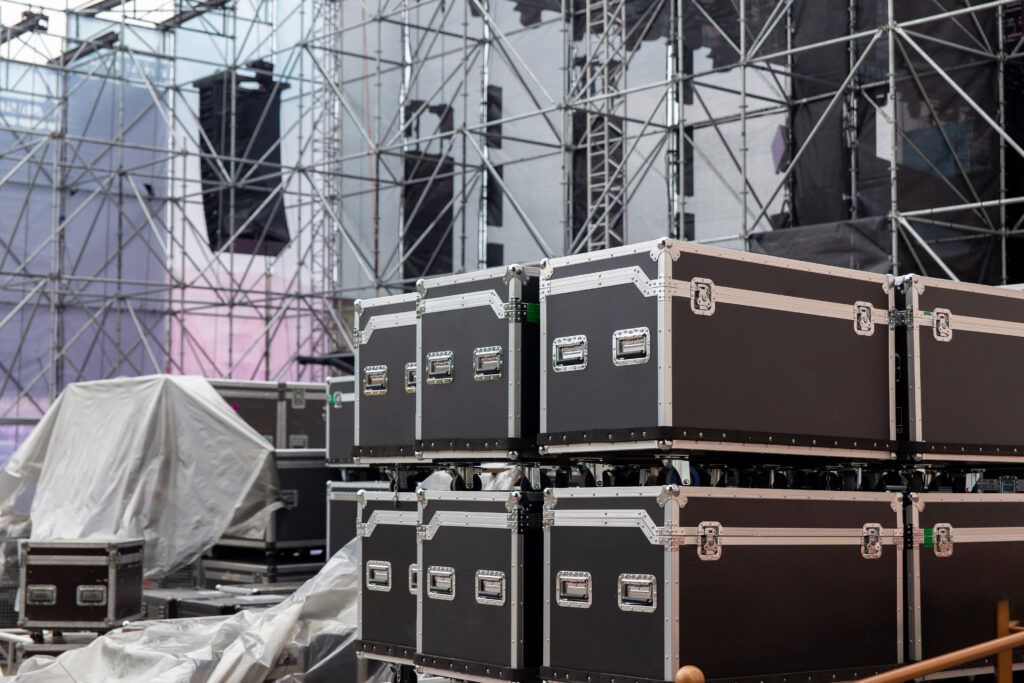
Not all production equipment moves the same way. Lighting rigs, truss systems, and camera cranes have to be broken down and packed in a specific sequence to transport safely. Custom-built set pieces and period furniture require wrapping and, in some cases, custom crating to survive transport without damage. Audio equipment needs protection from vibration during the drive.
When a production involves set pieces or props with significant replacement value, we address this during the planning phase. The handling plan should reflect what is being transported, not just the dimensions and weight. For items that require custom crating, we build that into the scope and quote it accordingly. Nothing about the handling plan should be a surprise on load-in day.
How Deadlines Drive Every Decision
In a production environment, every decision runs through the filter of the deadline. If load-in is at 6 a.m., the crew needs to be staged no later than 5:30. If three vendors are sharing a single freight elevator window, the sequence of who goes first needs to be worked out before anyone arrives. If the BQE or the FDR adds 45 minutes to the drive from Queens, the departure time needs to account for that.
These are not complicated problems. They become problems when planning happens at the last minute or when the moving company has not worked in a production context before.
We build time buffers into the production move plan for exactly these reasons. Traffic in New York City is unpredictable. Loading docks run late. Freight elevators break. A plan that only works if nothing goes wrong is not a plan that works in this city. The buffer is what separates a manageable delay from a blown deadline.
Building a Move Plan That Holds on the Day
The production move plans that hold up are the ones built with input from every party who is on-site. Knowing what the rigging company needs, when the AV crew is arriving, and what the venue’s access rules look like on the ground means we can build a plan that fits with all of it, rather than a plan that only works in the ideal version of the day.
When we take on a production or event move, we ask for this information as part of the planning conversation. What is the load-in sequence? Who else is on-site and when? What does the venue require from vendors on access and insurance? Are there items that need climate protection or handling outside of standard procedures?
The goal is a move plan built around the actual conditions of the job, not an idealized version of them. That is what makes the difference between a production move that runs and one that stalls.
If you have a production or event move coming up in New York City, request a flat-fee quote and we will go through the scope, the timeline, and the venue logistics together.